
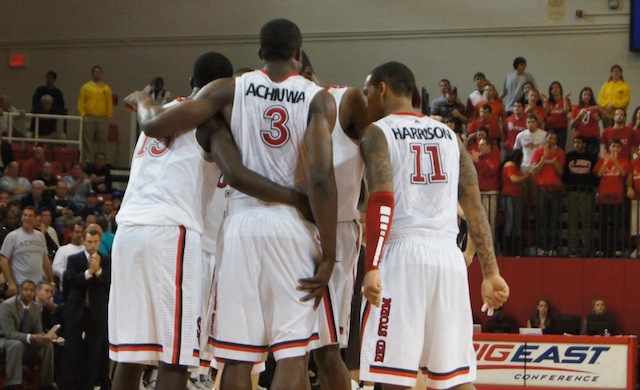
In the absence of head coach Steve Lavin, who continued to rest following prostate cancer surgery, Mike Dunlap’s team surrendered 21 offensive rebounds and turned the ball over 14 times in a 78-64 loss Saturday evening at Carnesecca Arena.
There were some who could have helped St. John’s rebounding deficiency. Problem was, they were spread out across the northeast; one in Philadelphia, one in New Hampshire, and one in Maine.
But if you ask, this team will tell you ineligible players are no excuse, and they’re right.
Systematically, there are ways for this team, with this size and depth, to win basketball games.
Take a look at the loss against much more skilled and physical Arizona: the Red Storm were nearly even on the boards, despite allowing 14/29 shooting from three-point range and, had Nurideen Lindsey not fouled out late in the second half, could perhaps have gotten a victory.
The main focus of the St. John’s zone is threefold: Keep big guys (Moe Harkless and God’sgift Achiuwa) out of foul trouble, try to compensate for lack of size by forcing teams to the perimeter, and conserve energy because of the short bench.
But there is one thread that holds all of this together: rebounding.
As assistant coach Mike Dunlap has said, living only by the three-pointer, “is a tough way to live.” But if teams get second-chance opportunities and putbacks, living gets easy.
That’s what happened Saturday versus Northeastern.
Joel Smith, a 6’4”, 180-pound guard, went 7/12 from three-point range, piling up 29 points and 10 rebounds.
Fellow guard Jonathan Lee, standing just 6’2” tall, had four offensive rebounds, on his way to 17 points.
What caused the rebounding deficit?
There were times, both defensively and offensively, where the Red Storm were out of sync.
Early defensive pressure by the Huskies added something St. John’s had not yet seen. This, consequently, translated to their own defensive end.
Instead of rotating, the Red Storm were caught chasing the ball. At any point in the game, the ball is moving faster than anyone on the court. This not only made for open shots from the perimeter, but Huskies left open under the basket for offensive rebounds and second-chance points.
The important takeaway is that the zone works. Yes, it looks bad when a team is consistently knocking down threes, but it has allowed the Red Storm to have flexibility and stay out of foul trouble.
Arizona was 11/31 from inside the arc. Texas A&M shot just 4/15 from three-point land. Both were competitive and, ultimately, winnable games.
As repetitive as the beginnings of games have seemed to be (early deficit, strong three-point shooting) the zone is a necessity.
There are no systemic problems. Now, it is all about execution.

Daniel,
Respectfully disagree with your premise. The question is not whether SJU should be playing zone or not. The question is whether they should be playing the type of zone they’re playing. And the answer is unquestionably, no.
For two years now, we’ve watched teams feast on us from three point range, regardless of whether they were previoulsy regarded as good deep shooting teams. (see Rams,Fordham).Thats two different teams, with two different sets of players- one experienced group, one inexperienced group. The rebounding issue is not a seperate problem,it’s a symptom of the problem- which is that this hyper-extended, over-agressive “match up zone” cannot be effectively played against most D1 teams without giving up numerous wide open looks per game and allowing way too many offensive boards.
You talked about the Arizona game; actually it was a great example of my point. We gave up a ridiculous amount of wide open threes early, but once we got into foul trouble we dialed back the aggressiveness dramatically. The result was fewer open looks and more guys available to rebound because they hadnt over rotated and wound up out on the perimenter.
I dont know whether it was a tactical decision to do the same thing against A&M or they were just exhausted, but they seemed to dial it back in that game as well, to good effect IMHO. I wasnt at Carnesecca yestersay, but I cant imagine they gave up 50% from three and got killed on the offensive glass by a mid major program unless they went back to the chaotic, undisciplined zone they had been playing.
The bottom line is, its not the execution, it IS the zone. Why they’re running a defense which is geared to give up open threes which are such a joke my sixth grade son and guys from Fordham can knock down with regularity, is beyond me. Mike Dunlap’s quote completely fails to acknolwledge the importance of the three pointer in college basketball; nobody lives solely by the three, but most of the top teams have 5 or 6 guys who can knock down a contested three, much less an open one, , and almost any D1 player who isnt a post player can knock down 30%, which is the equivalent of 50% from two.
We can score with people 2 for 2. What we cant do is constantly get layups in transition or on Nuri drives, and then give up wide open threes and lose ground.
You’re right, they have to play SOME zone. But not the one they’re playing now.
Keep up the great work.